
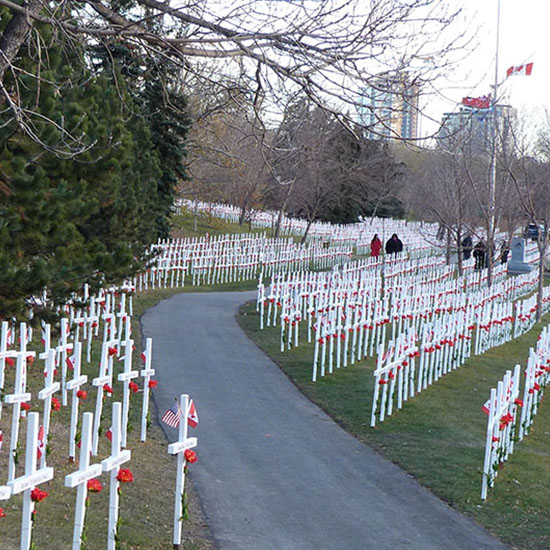
Field of Crosses lit by 3,000 candles on eve of Nov. 11
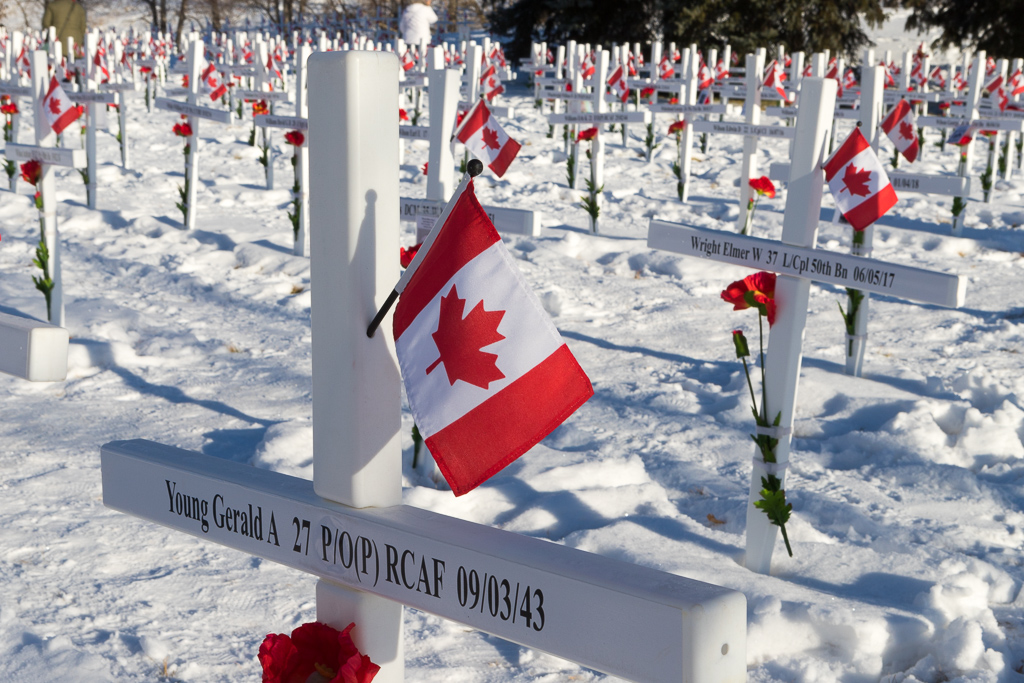
The Field of Crosses alongside Memorial Drive was lit up Sunday night by more than 3,000 candles in honour of the sacrifices made by Canadian soldiers. "There's five acres of crosses here and each one of them was a real human being who got on a train, probably at the...
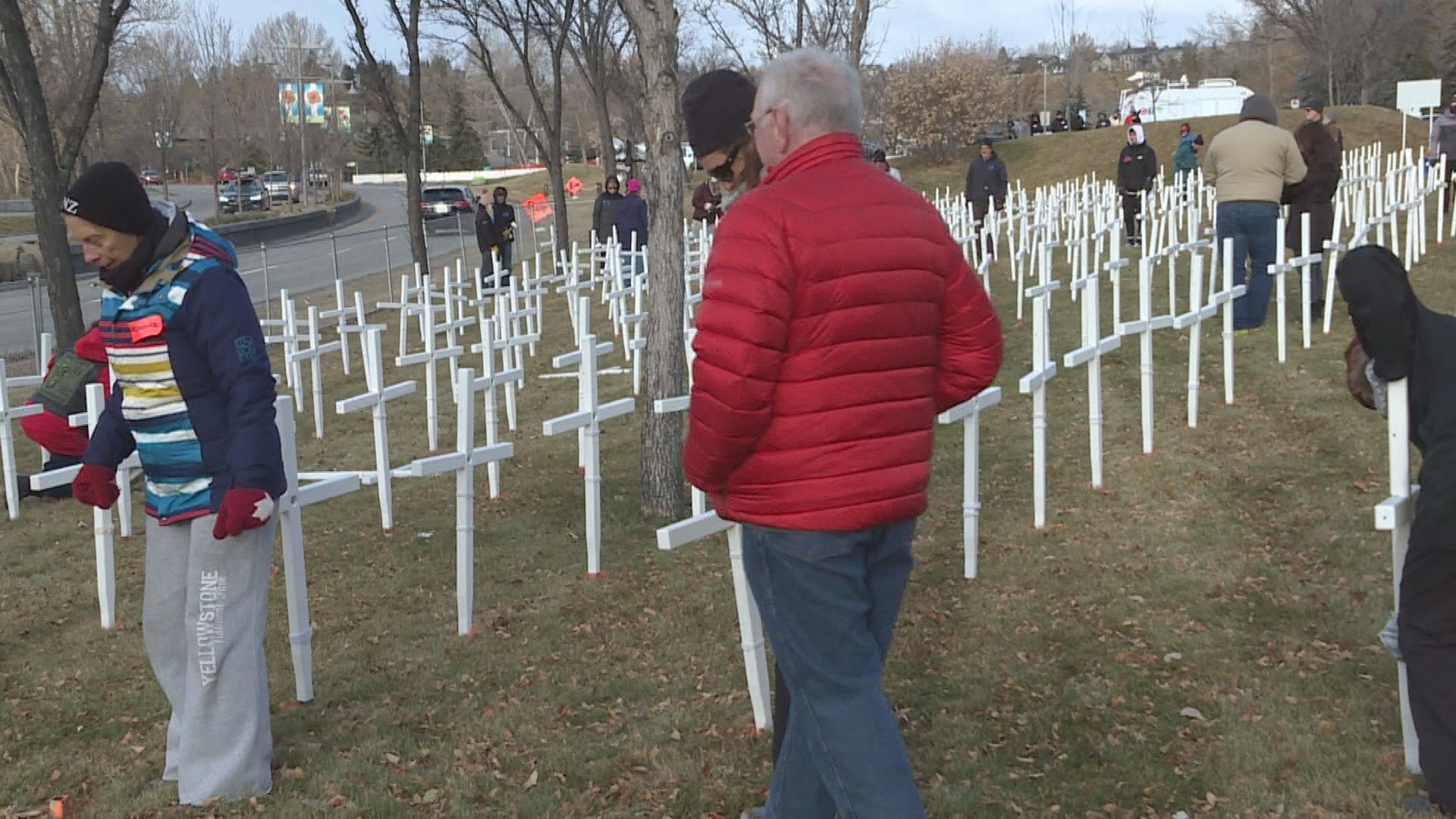
How you can participate in Calgary’s 2019 Field of Crosses commemorations
Tom Leppard and Murray McCann of the Field of Crosses Memorial join Global News Morning Calgary to discuss how you can participate in the 2019 commemorations. Watch the video
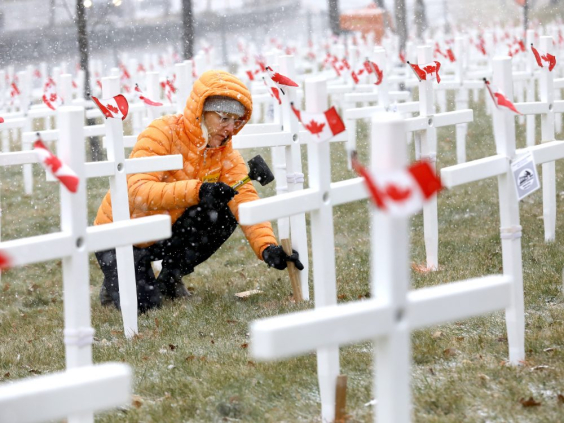
Field of Crosses returns to Memorial Drive ahead of Remembrance Day
It’s a stirring reminder of the sacrifices made by Canadian soldiers, and for the 11th year running row upon row of white crosses are being installed along Memorial Drive just in time for Remembrance Day. Hundreds of volunteers began placing some 3,400 of the ivory...
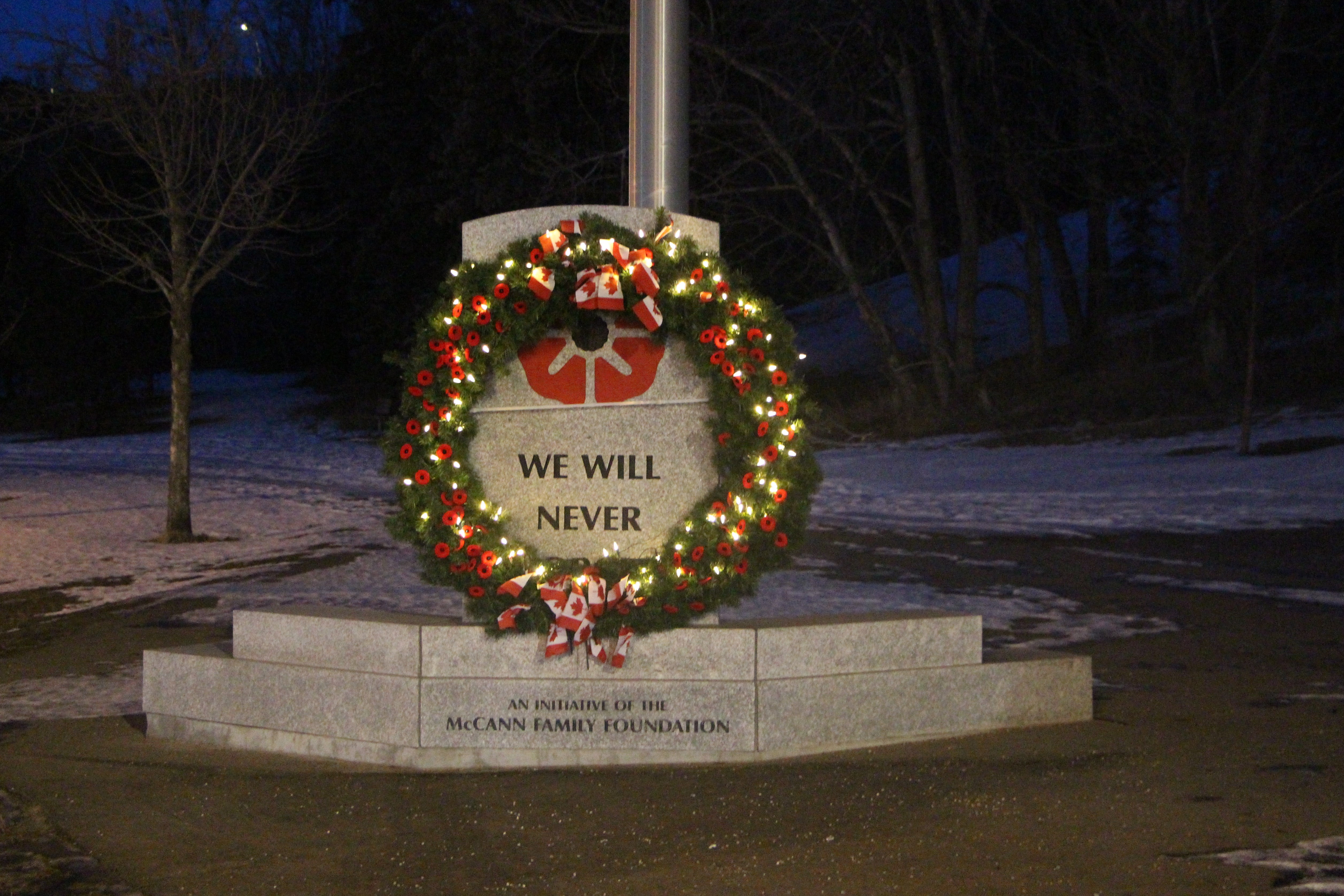
Christmas Wreath
Happy Holidays. Christmas wreath on the Field of Crosses cenotaph adjacent Memorial drive on display until the New Year. Lest we forget.
Preparing Crosses.
Dozens of volunteers spent three weekends washing, organizing and bundling nearly 3500 crosses of those Southern Albertans who made the ultimate sacrifice. Global Television was there to share the story and the personal connection many volunteers had to the crosses....

𝐓𝐡𝐞 𝐂𝐫𝐨𝐬𝐬𝐞𝐬 𝐀𝐫𝐞 𝐈𝐧!
The weather held out for us and we were able to get the crosses installed this past weekend October 24 & 25th ! What is mostly an empty field throughout the year has once again miraculously (with the help of many hands) transformed into The Field of Crosses. Kudos to the many helping hands – from individual volunteers to hockey teams, cadet groups, corporate sponsors and clubs – WE COULDN’T HAVE DONE IT WITHOUT YOU !!
Classroom At The Crosses has begun this week and the Eleven Days of Remembrance will be commemorated November 1st to 11th. Looking forward to seeing you all at The Field of Crosses.

18 CommentsComment on Facebook
What a beautiful day for site prep at the Field of Crosses! ☀️🇨🇦
Last weekend, we were treated to some wonderful warm October weather as preparations got underway for this year's Field of Crosses display.
A huge thank you to PCL Construction, Herc Equipment Rentals and all our incredible volunteers who came out to help install the bases and get the field ready for cross installation on October 24th!
We're crossing our fingers for another sunny, warm day tomorrow! ☀️🤞 What are our chances?! We'll find out soon enough!
www.fieldofcrosses.com/
6 CommentsComment on Facebook
𝐒𝐄𝐆𝐆𝐈𝐄 𝐌𝐢𝐜𝐡𝐚𝐞𝐥 𝐉 𝐀 𝐒𝐌
Age: 21 – Cpl PPCLI
Date of Death: 03/09/2008
Michael James Alexander Seggie was born on November 22, 1986, in Calgary, Alberta, to James and Shirley Seggie. He was the beloved brother of Michelle. When Michael was three years old, the family moved to Winnipeg, Manitoba.
Michael graduated from John Taylor Collegiate High School in 2002. He loved playing baseball with the St. James A’s and enjoyed playing hockey for fun with his friends.
Michael began his military career with the 191 Air Cadet Squadron. In June 2004, he joined the Royal Winnipeg Rifles Reserve, where he completed his Basic Military Infantry Training. He also played hockey for the RWR hockey team, the Lil Black Devils.
Inspired by his family’s proud tradition of military service, Michael followed in the footsteps of his grandfather, uncle, and father, who all served with the Princess Patricia’s Canadian Light Infantry (PPCLI).
Michael transferred to the Regular Force on March 30, 2006. Following his training in Wainwright, Alberta, he was posted to the 2nd Battalion, Princess Patricia’s Canadian Light Infantry, in Shilo, Manitoba.
In February 2008, Michael deployed to Afghanistan with his unit. During the deployment, he was promoted to Corporal and received the Canadian Expeditionary Force Command (CEFCOM) Commendation for his actions on March 27, 2008, while serving in Afghanistan.
Corporal Michael James Alexander Seggie died on active service on September 3, 2008, during a firefight with insurgents in Afghanistan. The armoured vehicle in which he was travelling was struck by an anti-armour weapon while his unit was conducting a security patrol in the Zharey District of Kandahar Province.
Corporal Seggie was one of three Canadian soldiers killed in the attack, alongside Corporal Andrew Paul Grenon, 23, and Private Chadwick James Horn, 21. All three were infantrymen with the 2nd Battalion, Princess Patricia’s Canadian Light Infantry (PPCLI) Battle Group, based in Shilo, Manitoba. Five other Canadian soldiers were wounded in the engagement.
Private Horn was posthumously awarded the Sacrifice Medal (SM).
Corporal Michael James Alexander Seggie is buried at Meadow Lea Cemetery in Meadow Lea, South Interlake, Manitoba.
On November 4, 2010, the Government of Manitoba named Seggie Lake in his memory.
Each November, during the Eleven Days of Remembrance in Calgary, Alberta, the Field of Crosses honours Corporal Michael James Alexander Seggie and commemorates his service and sacrifice.
www.fieldofcrosses.com/
105 CommentsComment on Facebook
𝐇𝐎𝐑𝐍 𝐂𝐡𝐚𝐝𝐰𝐢𝐜𝐤 𝐉 𝐒𝐌
Age: 21 – Pte PPCLI
Date of Death: 03/09/2008
Chadwick (Chad) James Horn was born on October 14, 1986, in Calgary, Alberta. He was the son of Anita Horn and James Alexander Horn, and the brother of Tiffany. He was also the stepson of Jim Bowes.
Chad enjoyed Cubs, Scouts, and street hockey. In 2004, he graduated from Henry Wisewood High School in Calgary. Two years later, on March 7, 2006, he enlisted in the Canadian Armed Forces. Upon completing his Basic Infantry Qualification course in 2007, he was posted to the 2nd Battalion, Princess Patricia’s Canadian Light Infantry (2 PPCLI), in Shilo, Manitoba.
Private Chadwick James Horn died on active service on September 3, 2008, during a firefight with insurgents. Their armoured vehicle was struck by an anti-armour weapon while they were conducting a security patrol in Zharey District, Kandahar Province, Afghanistan.
His Commander praised Private Horn, describing him as a highly professional, hardworking young soldier and had unlimited potential. He was regarded by many in his company as the best LAV (Light Armoured Vehicle) gunner. Horn’s ability to act under fire had saved many lives during his tour.”
Private Horn was posthumously awarded the Sacrifice Medal (SM).
Private Chadwick James Horn was one of three Canadian soldiers killed in the devastating attack, alongside Corporal Andrew Paul Grenon, 23, and Corporal Michael James Alexander Seggie, 21. All three were infantrymen with the 2nd Battalion, Princess Patricia’s Canadian Light Infantry (PPCLI) Battle Group, based in Shilo, Manitoba. Five other soldiers were wounded in the engagement.
Each November, during the Eleven Days of Remembrance in Calgary, Alberta, the Field of Crosses honours Private Chadwick James Horn and commemorates his service and sacrifice.
124 CommentsComment on Facebook