
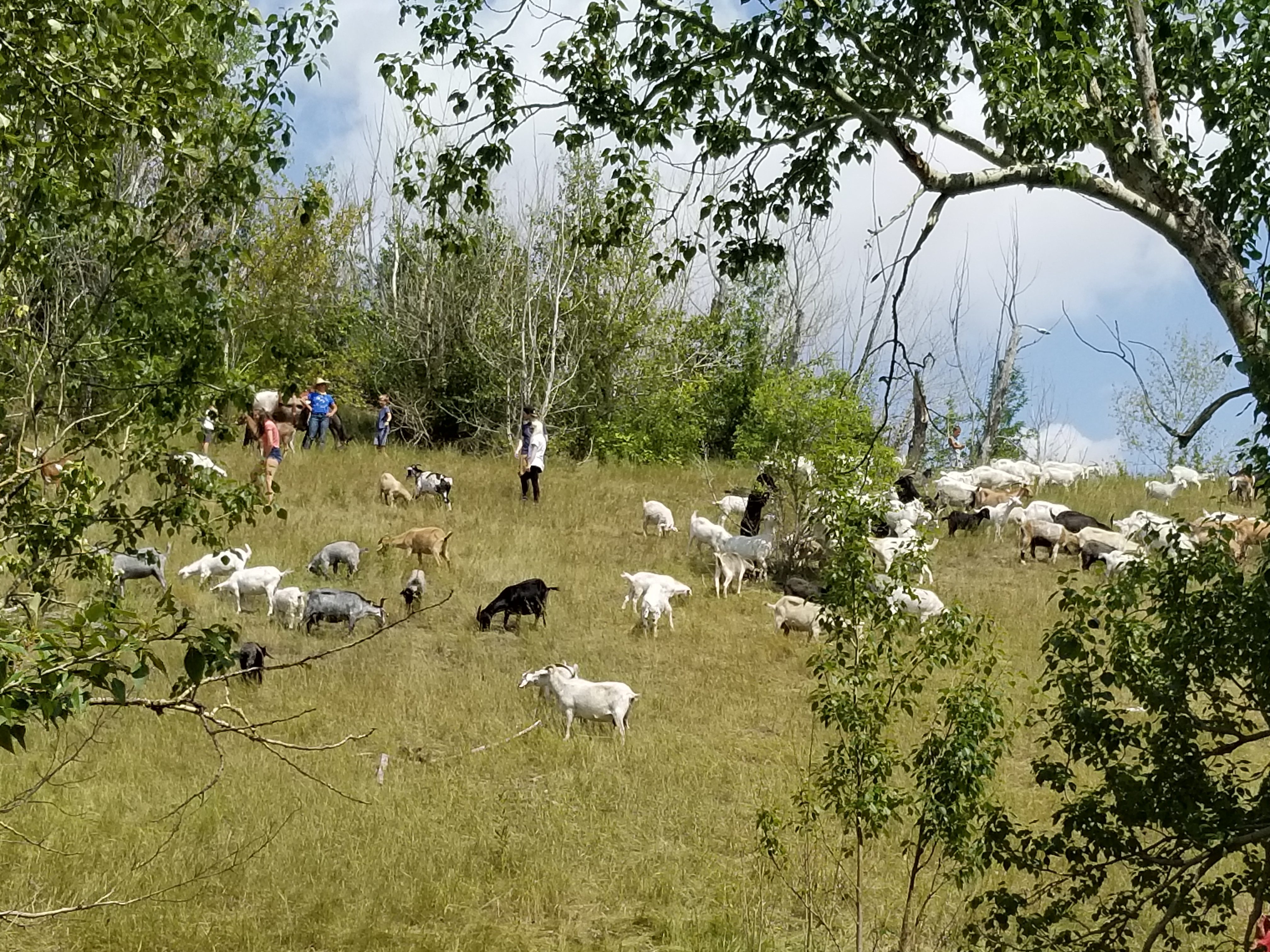
Goats Grazing near Field of Crossses
The City of Calgary has hired a herd of goats to browse the grass on the heights overlooking the Field of Crosses. This "Green solution" it is hoped will return the slopes to their original grasses. Non-native grasses and weeds are a veritable Goat buffet. The Field...
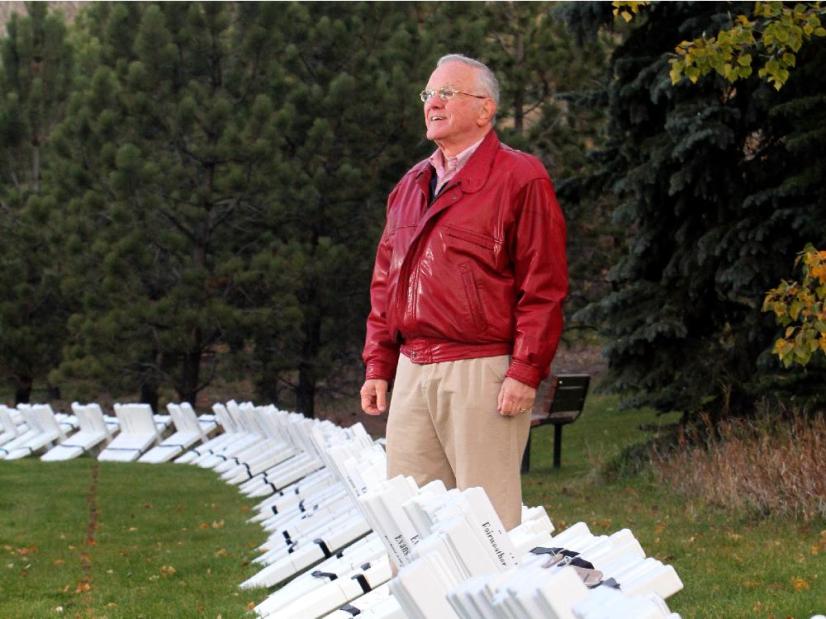
Murray McCann, Field of Crosses Founder, Calgary’s citizen of the year.
MURRAY MCCANN: CITIZEN OF THE YEAR. Congratulations to Murray McCann, founder of the Field of Crosses, recently honoured by the City of Calgary as Calgary's citizen of the Year. Click link for Calgary Herald's coverage. Murray McCann Announced as Calgary's...
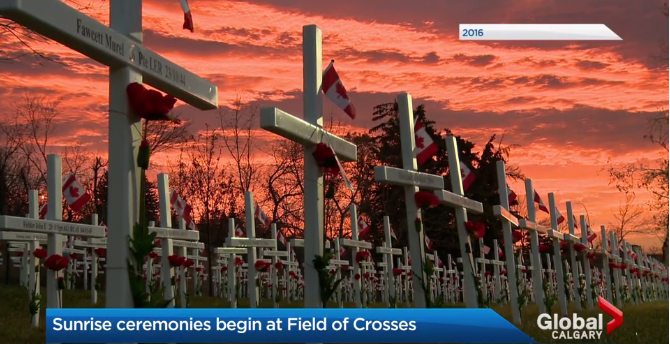
Sunrise and sunset ceremonies begin at Calgary’s Field of Crosses Memorial Project.
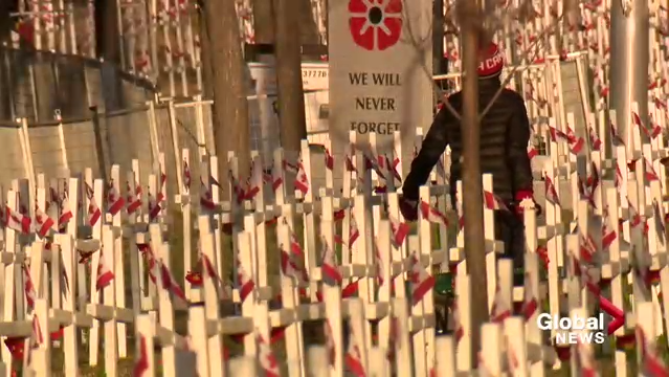
Calgarians are invited to attend a series of sunrise and sunset ceremonies at the Field of Crosses Memorial Project starting on Wednesday. Click to watch video. The annual display along Memorial Drive includes over 3,400 white crosses, each representing a...
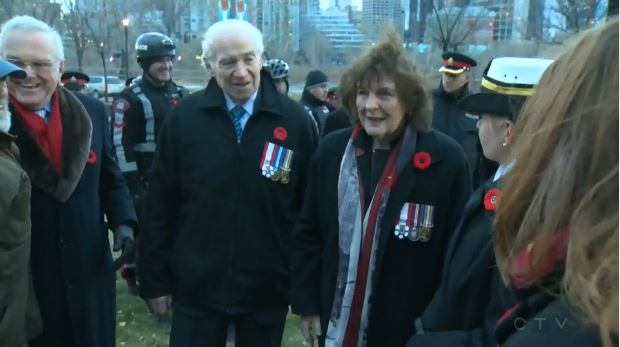
Calgarians gather to honour fallen soldiers in ceremony leading to Remembrance Day
For the first time this year, people gathered at the Field of Crosses on Memorial Drive in Calgary on Wednesday to pay their respects to Southern Alberta's fallen soldiers. Click to watch the video. More than 3,400 white crosses, each bearing the name of a man or...
‘I can never imagine myself doing that’: Calgary students honour Alberta’s war dead
It was a big task for staff and students from Delta West Academy: out in the chilly air Monday morning adorning 3,400 crosses with donated poppies at Calgary’s Field of Crosses on Memorial Drive. Click to watch video. Students from kindergarten to high...

Eleven Days of Remembrance Begins November 1 🇨🇦
Beginning November 1, Calgary’s Field of Crosses will once again welcome our community to come together in remembrance of the thousands of brave Canadians who made the ultimate sacrifice for our country.
Throughout the Eleven Days of Remembrance, we invite you to join us for daily sunrise and sunset ceremonies, each offering an opportunity to reflect, pay tribute and honour those who served.
This year’s special days of remembrance include:
November 1: Memorial Cross Families Day
November 2: Royal Canadian Air Force
November 3: Royal Canadian Navy
November 4: Canadian Army
November 5: 100th Anniversary of the Royal Canadian Legion
November 6: First Responders and Animals in War
November 7: Youth Day
November 8: Indigenous Veterans Day
November 9: Women of War and Honouring Field of Crosses Jewish Fallen
November 10: UN Peacekeepers and Night of Lights
November 11: Remembrance Day, Honouring the Fallen of Afghanistan
On the evening of November 10, the Field will be illuminated by more than 3,700 glowing lanterns during our annual Night of Lights, a beautiful and moving tribute that continues through the night until sunrise on Remembrance Day.
Our Remembrance Day Ceremony on November 11 begins at 10:10 AM.
The Field of Crosses is open to visitors 24 hours a day throughout the eleven days. Whether you attend a ceremony, walk among the crosses or simply take a quiet moment to reflect, we welcome you to be part of this meaningful tradition.
Every cross represents a life, a family and a sacrifice that should never be forgotten.
For ceremony times and full event details, please visit:
www.fieldofcrosses.com/event-details/
We Will Remember Them.
#FieldOfCrosses #ElevenDaysOfRemembrance #RemembranceDay #LestWeForget #Calgary #CanadaRemembers

0 CommentsComment on Facebook
𝐓𝐡𝐞 𝐂𝐫𝐨𝐬𝐬𝐞𝐬 𝐀𝐫𝐞 𝐈𝐧!
The weather held out for us and we were able to get the crosses installed this past weekend October 24 & 25th ! What is mostly an empty field throughout the year has once again miraculously (with the help of many hands) transformed into The Field of Crosses. Kudos to the many helping hands – from individual volunteers to hockey teams, cadet groups, corporate sponsors and clubs – WE COULDN’T HAVE DONE IT WITHOUT YOU !!
Classroom At The Crosses has begun this week and the Eleven Days of Remembrance will be commemorated November 1st to 11th. Looking forward to seeing you all at The Field of Crosses.
30 CommentsComment on Facebook
What a beautiful day for site prep at the Field of Crosses! ☀️🇨🇦
Last weekend, we were treated to some wonderful warm October weather as preparations got underway for this year's Field of Crosses display.
A huge thank you to PCL Construction, Herc Equipment Rentals and all our incredible volunteers who came out to help install the bases and get the field ready for cross installation on October 24th!
We're crossing our fingers for another sunny, warm day tomorrow! ☀️🤞 What are our chances?! We'll find out soon enough!
www.fieldofcrosses.com/
6 CommentsComment on Facebook
𝐒𝐄𝐆𝐆𝐈𝐄 𝐌𝐢𝐜𝐡𝐚𝐞𝐥 𝐉 𝐀 𝐒𝐌
Age: 21 – Cpl PPCLI
Date of Death: 03/09/2008
Michael James Alexander Seggie was born on November 22, 1986, in Calgary, Alberta, to James and Shirley Seggie. He was the beloved brother of Michelle. When Michael was three years old, the family moved to Winnipeg, Manitoba.
Michael graduated from John Taylor Collegiate High School in 2002. He loved playing baseball with the St. James A’s and enjoyed playing hockey for fun with his friends.
Michael began his military career with the 191 Air Cadet Squadron. In June 2004, he joined the Royal Winnipeg Rifles Reserve, where he completed his Basic Military Infantry Training. He also played hockey for the RWR hockey team, the Lil Black Devils.
Inspired by his family’s proud tradition of military service, Michael followed in the footsteps of his grandfather, uncle, and father, who all served with the Princess Patricia’s Canadian Light Infantry (PPCLI).
Michael transferred to the Regular Force on March 30, 2006. Following his training in Wainwright, Alberta, he was posted to the 2nd Battalion, Princess Patricia’s Canadian Light Infantry, in Shilo, Manitoba.
In February 2008, Michael deployed to Afghanistan with his unit. During the deployment, he was promoted to Corporal and received the Canadian Expeditionary Force Command (CEFCOM) Commendation for his actions on March 27, 2008, while serving in Afghanistan.
Corporal Michael James Alexander Seggie died on active service on September 3, 2008, during a firefight with insurgents in Afghanistan. The armoured vehicle in which he was travelling was struck by an anti-armour weapon while his unit was conducting a security patrol in the Zharey District of Kandahar Province.
Corporal Seggie was one of three Canadian soldiers killed in the attack, alongside Corporal Andrew Paul Grenon, 23, and Private Chadwick James Horn, 21. All three were infantrymen with the 2nd Battalion, Princess Patricia’s Canadian Light Infantry (PPCLI) Battle Group, based in Shilo, Manitoba. Five other Canadian soldiers were wounded in the engagement.
Private Horn was posthumously awarded the Sacrifice Medal (SM).
Corporal Michael James Alexander Seggie is buried at Meadow Lea Cemetery in Meadow Lea, South Interlake, Manitoba.
On November 4, 2010, the Government of Manitoba named Seggie Lake in his memory.
Each November, during the Eleven Days of Remembrance in Calgary, Alberta, the Field of Crosses honours Corporal Michael James Alexander Seggie and commemorates his service and sacrifice.
www.fieldofcrosses.com/
106 CommentsComment on Facebook